Total Pageviews

Showing posts with label Protest. Show all posts

Friday, March 2, 2012

Occupy Movement Hits San Quentin

 from: http://www.sfbg.com/politics/2012/02/22/occupy-4-prisoners-hits-san-quentin

 Occupy 4 Prisoners hits San Quentin

|

The crowd marches at Occupy San Quentin
IMAGE VIA KRISSANA LIMLAMAI FOR OCCUPYSF MEDIA

About 800 protesters marched to San Quentin’s East Gate in a day to protest what they called inhumane conditions in prison Feb. 20
Protesters called for an end to the practice of trying children as adults, three strikes laws, life sentences, life without the possibility of parole, and the death penalty.They did not call for the dismantling of the prison system or an end to the practice of incarceration, as Chip Johnson implies here.
In San Quentin-- and in prisons across the country—inmates are subjected to solitary confinement, sometimes for decades. Kids as young as 13 are tried as adults and sometimes sentenced to life without the possibility of parole. In three-strikes states, people are sentenced to decades in prison for non-violent crimes that sometimes amount to less than a couple hundred dollars in damages. And in death penalty states, state-sponsored execution means that lives, sometimes innocent, are thrown away.
Twenty-four US states do not have three strikes laws, many countries cap prison sentences at 15 years regardless of the severity of the crime, and only one European country- Belarus- continues to impose the death penalty. The United States incarcerates its citizens at a rate that far surpasses any other country in the world; second on the list in Rwanda.
Conditions and laws like these have spurred decades of prison reform and prison abolition activism, both from inmates and supporters on the outside. Feb. 20, this movement joined with Occupy Oakland to protest outside San Quentin prison and demand that these issues be addressed.
As protesters arrived, organizers blasted music, hoping to reach the ears of prisoners. Dozens of prison guards and representatives from the Marin County sheriff’s department were stationed in front of the prison gate, and well as on hills looking down on the protest group.
The loud music continued with a performance from the Brass Liberation Orchestra, and subsequently a drumming ritual.
“As First Nations people, we’re no strangers to occupation. We’re also no strangers to prison. The first prisons were the reservation and the slave plantation,” said George Galvis, Executive Director of Communities United for Restorative Youth Justice.
“We have post-colonial stress disorder in our communities,” added Galvis.
Author, film producer (Redemption: The Stan Tookie Williams Story) and 2006 California gubernatorial candidate Barbara Becnel helped facilitate the event.
In her opening statements, Becnel praised the crowd, packed with Occupy activists, family members of incarcerated people, formerly incarcerated people, and others.
“We should really be proud of ourselves today. Because today, we are history makers. We have merged the prison rights movement with the Occupy movement,” said Becnel to an eruption of applause.
Throughout the program, speakers read solidarity statements addressed to Occupy Oakland from prisoners across the country, including Mumia Abu Jamal, Leanard Peltier, Kevin Cooper, and group statements from Pelican Bay human rights organizers, and those involved in state-wide prison strikes in Georgia.
A movement has coalesced around the claim that Cooper, a death row inmate at San Quentin since 1985, is innocent. Cooper was denied an appeal in 2009 in a ninth-circuit court case in which five judges dissented, declaring that, “the state of California may be about to execute an innocent man.” Their 103-page dissent statement includes descriptions of evidence tampering leading to Cooper’s conviction.
Cooper helped call for the Occupy 4 Prisoners day of action.
Speakers at the rally called for Cooper’s freedom, and for the end of death row entirely.
Becnel related a story about some prisoners, charged with life without the possibility of parole, that she had met while campaigning against the death sentence for Stan "Tookie" Williams.
The men, Becnel said, told her: "We only leave here in a casket also. We are also dead men walking."
Speakers also decried the use of solitary confinement as a punishment in prisons.
Sarah Shourd, known for her imprisonment in Iran after accidentally crossing the border during a hike, spoke along with fellow imprisoned hikers Josh Fattal and Shane Bauer.
Shourd, who was held in solitary confinement for 14 months, related her experiences.
“After just two months my mind began to slip. I would spend large portions of my day crouched down by a small slot in my door, listening for any sounds from the outside that might distract me from the sheer terror of my isolation.”
A statement from a Texas prisoner, read by an Occupy Wall Street organizer, also addressed solitary confinement.
“We tend to think of man as a collection of individuals, each complete in himself, who just happen to come together to satisfy certain needs. Actually, however, there is nothing distinctly human that can be exhibited by an individual in isolation,” said the philosophical letter.
The Pelican Bay Hunger Strike last year highlighted solitary confinement, and prisoners demanded an end to the practice, in which inmates are held in isolated rooms with no sunlight for 23 hours a day, often for years on end. Some inmates at Pelican Bay have been held in these conditions for over 30 years.
Organizers of the hunger strike called it off when the California Department of Corrections promised to investigate the issue, but started to strike again several months later when no changes had been made to any of the conditions that they were protesting.
Kelly Turner, 42, who was sentenced to 25 years to life for writing a bad check for $146.16 in 1997, was also placed in solitary confinement for one year. However, she focused her speech at the rally on California’s three strikes law, the legislation that turned what would have been a three-year sentence for forgery into a possible life sentence for Turner. Turner said she was lucky that good pro bono lawyers defended her, and would likely still be in prison had they not; she now owns her own business.
Turner, who advocates for Families to Amend California Three Strikes (FACTS), urged the crowd to vote for an initiative to amend the law that is slated to appear on the California ballot this November. 
In her speech, Turner described meeting women in the Central California Women’s Facility is Chowchilla that were also serving decades-long sentences after having been charged with a third strike.
“I am here today for the woman that was on my dorm that had 27 years to life for drinking a 99 cent lemon line soda out of a store. Or the woman who stole a jar of Vaseline, a bottle of vitamins, two pairs of boxers,” said Turner.
Tatiana, a young prisoners rights advocate who spent time in juvenile hall, read a statement from incarcerated youth Veronica Hernandez.
Hernandez, 20, has been imprisoned since age 16.
She was tried as an adult, an outcome that she attributes to a public defender who did not do his best to fight for her.
"There are no law libraries or legal services at juvenile hall, so a juvenile, for better or for worse, is entirely dependent on his or her court-appointed attorney, and must trust that he or she will lead them in the right direction. Unfortunately for me, that direction was to adult court. I now face a life sentence should I be convicted," said Hernandez in her statement.
No speaker argued for the dismantling of the prison system, instead focusing on what they saw as unjust sentencing and inhumane treatment in prisons.
In a statement calling for Occupy 4 Prisoners, Kevin Cooper connected a call to end the death penalty with struggle for correct racial and economic justice and an end police brutality:
“America has a deep-seeded philosophy in which it only allows for the execution of its poorest people. These seeds have taken root and have grown in such a way that no person who this system sees as a ‘have-not’ is safe from the death machine. Whether they are within (San Quentin) or on a BART platform.”
Bauer also expressed the importance of tying prison rights to the Occupy movement, saying, “This Occupy movement needs to permeate the prisons. God forbid one day some people here will be on the other side of this fence. But when movements get strong, people start getting locked up. We should know this. This happens in every country. Prisons are places where movements are killed. But at the same time, when movements successfully permeate prisons, a space built to break people down, the movement is at its strongest. This is true all over the world.”
Occupy Oakland organizers have already been hit with bizarre and seemingly invalid charges, such as “lyching,” “bike,” “boat,” and umbrella. In one of the most extreme cases, Khali, an Occupy Oakland protester, may face life in prison after being arrested for a allegedly taking a blanket out of a garbage can. Advocates for Khali say that he was denied prescription medications in jail for ten days before allegedly assaulting a police officer; his third strike.
Well-known prison rights advocate and former Black Panther Elaine Brown ended the program. After remarking that “there aren’t enough songs in this movement,” she sang Oh, Freedom as the crowd peacefully exited the site, as several volunteers picked up any trash that was left behind.
“Before I’ll be a slave, I’ll be buried in my grave, and go home to my comrades and be free,” sang Brown.

Wednesday, February 29, 2012

CA Hunger Striker Dies

From: http://www.democracynow.org/2012/2/24/death_of_hunger_striking_california_prisoner

Death of Hunger-Striking California Prisoner Sparks New Outrage over Inmates’ Suffering

Prison
Questions are mounting over the state of California’s prison system following the death of a hunger-striking inmate protesting conditions behind bars. Christian Gomez, 27, died at Corcoran State Prison, just six days after he and about 30 fellow prisoners began refusing food. Gomez was one of thousands of California inmates who have staged hunger strikes in 12 prisons since July after the U.S. Supreme Court ruled that California prison overcrowding was causing "needless suffering and death" and ordered the state to reduce its number of prisoners. We speak with Gomez’s sister Yajaira Lopez and to attorney Carol Strickland of the Prisoner Hunger Strike Solidarity Coalition. "When he did get [to Corcoran State Prison], he did explain to us that he was participating in a hunger strike," Lopez says. "They were fighting for just fair treatment." [includes rush transcript]
Guests:
Yajaira Lopez, the older sister of Christian Gomez, a 27-year-old man who died while on a hunger strike at the Corcoran State Prison in California. Gomez died six days after he and 31 other inmates in the prison’s Administrative Segregation Unit began refusing food to protest restrictions on access to adequate healthcare, nutritious food, and legal services.
Carol Strickman, staff attorney at Legal Services for Prisoners with Children and a member of the Prisoner Hunger Strike Solidarity Coalition.

Tuesday, November 8, 2011

Meaning of CA Prisoner Hunger Strikes

What is the meaning of the California prisoner hunger strikes?

November 3, 2011

A statement in support of the hunger strikers

by Kevin Rashid Johnson
“If there is no struggle, there is no progress.” – Frederick Douglass
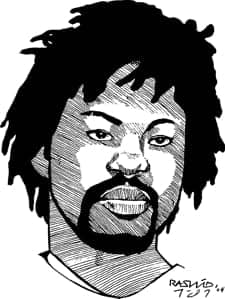
Rashid Johnson, self portrait
Six thousand six hundred California prisoners participated in a three-week-long hunger strike in July, seeking relief from unjust and inhumane conditions. In the face of California Department of Corrections (CDC) officials failing to honor settlement negotiations, the hunger strike resumed on Sept. 26, with nearly 12,000 prisoners participating in 13 of that state’s prisons.
It is a truism that oppression breeds resistance. Indeed, the Declaration of Independence enshrines the right and duty of the oppressed to resist their oppression.
In this era of capitalist oppression on a global scale, the hunger strike exhibits the very same humyn spirit, courage and outrage that drove millions across North Afrika and the Middle East this year to take to the streets in protest against oppressive governments. U.S. rulers, in the face of pretending to champion and support human rights, democracy and the demands for basic rights by people half a world away, can’t admit they practice abuses just as vile against their own subjects – right here in Amerika.
Hosni Mubarak, the U.S. puppet and Egyptian dictator who was driven out of Egypt by mass protests this year, was notorious for torturing his own people. But so too are U.S. officials. Indeed, one of the key protest issues of the California prisoners is the acute psychological torture of sensory deprivation in the CDC’s Security Housing Units (SHUs) – Pelican Bay’s SHU in particular. This torture can’t be honestly denied.
It has long been the game of U.S. officials, especially since the 2004 Guantanamo Bay and Abu Ghraib torture scandals, to pretend that psychological torture isn’t really torture at all. However, they secretly know the exact opposite to be true. According to torture experts, psychological – or “clean” torture – is the most destructive, sadistic and inhumane type of torture. Among the methods proven most effective is the very sort inflicted by design in the isolated cells of the SHUs, namely sensory deprivation.

According to torture experts, psychological – or “clean” torture – is the most destructive, sadistic and inhumane type of torture. Among the methods proven most effective is the very sort inflicted by design in the isolated cells of the SHUs, namely sensory deprivation.

Noted psychologist and torture expert, Dr. Albert Biderman, long ago found as to sensory deprivation, “The effect of isolation on the brain function of the prisoner is much like that which occurs if he is beaten, starved or deprived of sleep.”1 The very same U.S. Central Intelligence Agency that employed Biderman as one of its torture researchers and experimenters encoded these findings in its 1963 “Kubark Counterintelligence Interrogation” torture manual, confirming that:
1. The deprivation of sensory stimuli induces stress;
2. The stress becomes unbearable for most subjects;
3. The subject has a growing need for physical and social stimuli; and
4. Some subjects progressively lose touch with reality, focus inwardly, which produces delusions, hallucinations and other pathological effects.
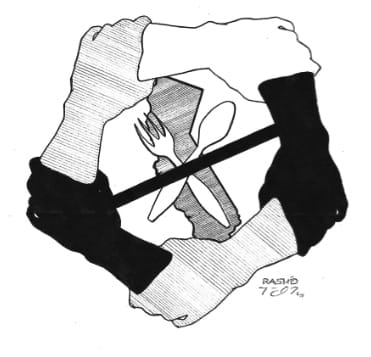
This drawing by Rashid Johnson of Red Onion Prison, Va., has become the icon of California prisoner hunger strike solidarity.
What’s more, over a century ago the U.S. high court found and denounced the same in U.S. prisons, in the face of In Re Medley, 134 U.S. 150 (1890).2 These findings have been repeated in U.S. courts today in response to the conditions of SHUs and super-maximum security prisons that have swept Amerika since the 1970s, alongside massive imprisonment of the poor and people of color. In one case concerning Pelican Bay’s SHU, the California federal courts found “many, if not most, inmates in SHU experience some degree of psychological trauma in reaction to their extreme social isolation and the severely restricted environmental stimulation in SHU.” Madrid v. Gomez, 889 F. Supp. 1146 (1995).
So it’s no wonder thousands of prisoners have been driven to starve themselves in desperate efforts for exposure and redress and to show they are worthy of basic humyn rights and dignity.
But the typical response of officials is to discredit the resistance of those who suffer at their hands by villainizing (or “dirtying up,” as Johnnie Cochran used to called it) the victim. It was done to Civil Rights activists from the 1950s-1970s who opposed and exposed racism – U.S. officials projected them as fronts for foreign Communists and denounced as “Soviet propaganda” graphic photos of Southern lynching that appeared in world media.

The typical response of officials is to discredit the resistance of those who suffer at their hands by villainizing (or “dirtying up,” as Johnnie Cochran used to called it) the victim.

Whatever happens to be the popular official enemy and bogeyman of the day is the label used to discredit those who resist official oppression. During the Cold War, the “enemy” was Communists. Then it was terrorists. In the era of mass incarceration and ongoing persecution of Black and Brown youth, it’s gangs. These labels are used to provoke visceral reactions in the population at large of fear, hatred and consequent disregard for and alienation against the oppressed. And true to form, the hunger strike has been “dirtied up” as the work of prison gangs:
This drawing by Rashid is called “Control Unit Torture.” To see a mind-blowing display of his work – all of it done while he himself is being tortured in a control unit – go to http://rashidmod.com/art/. Rashid encourages the use of his art for free. You’ll find a drawing on almost every topic you care about. – Art: Kevin “Rashid” Johnson
“The CDCR has continued to lie about the hunger strike – saying it was organized by gangs and attacking representatives of the strikers and others, depicting them as the ‘generals’ of the prison gangs and the ‘shot callers’ who order other prisoners to engage in gang violence.
“Dolores, whose son has been in the SHU for 10 years, said, ‘If that is their [the prisoners’] way of thinking, then why did they just conduct a hunger strike willing to risk their own lives, to suffer on a daily basis in a nonviolent demonstration that spread across California prisons involving thousands and thousands of men crossing all racial lines? It’s because they are human beings. They do have dignity, and they want to be heard.”3
Not coincidentally, another of the hunger strike’s main protest issues is the CDCR’s labeling prisoners as gang members upon the flimsiest grounds, then confining them in SHUs until they “debrief” – that is, finger other prisoners as gang members to be thrown in the SHU. Thus the only way to leave SHU is as a known informant to be ostracized and targeted as such by others.

The real purpose of SHUs and Super-maxes

The true purpose of SHUs isn’t to control gangs and racial violence. In fact, the CDCR has long instigated and facilitated prisoner-on-prisoner violence. From the notorious “gladiator fights” – where guards at CDCR’s Corcoran State Prison set up prisoner fights, gambled on the outcomes and then shot the prisoners for fun, killing eight and shooting 43 just between 1989 and 1994 – to massive numbers of prisoner-on-prisoner clashes instigated and manipulated by the notoriously corrupt California prison guards’ union to generate public support for building more prisons to increase prison jobs and dues-paying membership.
In 1999, prisoners at the New Folsom Prison went on a hunger strike protesting being forced onto prison yards with rivals. CDC Ombudsman Ken Hurdle rejected negotiations, stating: “Then you’d have two groups normally aligned on the yard together. They would have only staff as their enemy.”4 This admits officials are deliberately facilitating prisoner-on-prisoner violence as a technique of prison control.
This is what they fear in the unity shown by the hunger strikers. And it undermines the disunity they need to project them as animals.
Officials welcome and incite gang violence. It creates jobs, justifies their oppression and enhances their “control.” Even Crips co-founder Stanley Tookie Williams, who was executed by the CDCR, exposed this.5)

Officials welcome and incite gang violence. It creates jobs, justifies their oppression and enhances their “control.”

More revealing is that then-California Gov. Arnold Schwarzenegger rejected massive international pleas to stay Tookie’s execution on grounds that Tookie dedicated his book, “Life in Prison,” to Black revolutionary George Jackson, who was murdered by CDC officials in 1971. Schwarzenegger said the dedication “defies reason and is a significant indicator that Williams is not reformed.” Which brings us closer to exposing the real reasons SHUs exist.
The actual “leaders” officials fear and who are the prime targets of SHUs and super-maxes are those who are politically conscious and prove able to unite prisoners across racial and other lines.
The proliferation of SHUs and super-maxes began with the Marion Control Unit, which opened in 1972, following the murder of George Jackson and the peaceful 1971 Attica uprising that officials ended with the coldblooded murders of 29 prisoners and 10 civilians and the systematic humiliation and torture of hundreds of prisoners, provoking international outrage.

The actual “leaders” officials fear and who are the prime targets of SHUs and super-maxes are those who are politically conscious and prove able to unite prisoners across racial and other lines.

Like the brutal government responses to mass protests in Asia and Afrika this year, when the prisoners of Attica took to the yard in protest, with grievances articulated and represented by politically conscious prisoners, the official response was murder and torture, then high security torture units. In one of the few admissions on record, Ralph Arons, a former warden at Marion, testified in federal court: “The purpose of the Marion Control Unit is to control revolutionary attitudes in the prison and in society at large.”6 Yet U.S. officials deny confining or persecuting people for political beliefs.
Created during the reign of George W. Bush, this drawing by Rashid, titled “Fascism,” foreshadows Occupy Wall Street. – Art: Kevin “Rashid” Johnson
In fact, Pelican Bay officials recently banned my own book, “Defying the Tomb,” as “gang material,” a book of political writings and art, which many readers and reviewers have compared to George Jackson’s writings, whose books CDC banned in the 1970s as well. And with the resurgence of prisoners’ political consciousness, they’ve recently begun confiscating this book as “gang material.” Like Nazi book burnings and concentration camps, the object is to censor and persecute political consciousness and revolutionary culture amongst the most oppressed peoples. And “gang” labels are used to “dirty up” the people, practices and ideas they seek to repress.
Just as I am confined in a remote Virginia super-max, under “special” conditions of a SHU because of my political beliefs and having co-founded the New Afrikan Black Panther Party as a party of the oppressed, so too you’ll find in these units across Amerika those who hold and practice revolutionary political views and affiliations that are supposed to be constitutionally protected, not persecuted. As the high court once proclaimed:
“Our form of government is built on the premise that every citizen shall have the right to engage in political expression and association. This right was enshrined in the First Amendment of the Bill of Rights. Exercise of these basic freedoms in America has traditionally been through the media of political associations. Any interference with the freedom of a party is simultaneously an interference with the freedom of its adherents. All political ideas cannot and should not be channeled into the programs of our two major parties. History has amply proved the virtue of political activity by minority, dissident groups ….”7
But contrast these political ideals with the political reality that such parties face at the hands of officials, as admitted by Justice Hugo Black: “History should teach us … that … minority parties and groups which advocate extremely unpopular social or governmental innovations will always be typed as criminal gangs and attempts will always be made to drive them out.”8)
This is the function of the SHUs like those that California’s prisoners are protesting, and the ones used as a weapon to censor and repress political consciousness.
Resistance to the oppression of these units is the meaning of the hunger strikes. Amerika’s oppressed and disenfranchised victims of modern penal enslavement and the New Jim Crow are struggling like those of generations past for recognition and respect as humyn beings. As a party of the oppressed, especially the imprisoned, the NABPP-PC stands in unity with the heroic struggles of California’s entombed and calls on all freedom-loving people everywhere to take up their cause.

Resistance to the oppression of these units is the meaning of the hunger strikes.

Dare to struggle! Dare to win! All Power to the People!
Rashid Johnson, a prisoner in Virginia, has been held in segregation since 1993. While in prison he founded the New Afrikan Black Panther Party – Prison Chapter. Rashid is also the artist who drew the image that has been used extensively during the strikes of arms linked in unity and a crossed out spoon and fork. His book, “Defying the Tomb,” with a foreword by Russell “Maroon” Shoats, has been banned as “gang literature” by Pelican Bay State Prison. It can be ordered at leftwingbooks.net, by writing to Kersplebedeb, CP 63560, CCCP Van Horne, Montreal, Quebec, Canada H3W 3H8, or by emailing info@kersplebedeb.com. Send our brother some love and light: Kevin “Rashid” Johnson, 1007485, Red Onion State Prison, P.O. Box 1900, Pound, VA 24279.

Rashid’s art and writing are featured in this video. – Video: Black Agenda Report